Taking a Museum to the World: The Tanzanite Experience’s Global Rebrand Journey
A gemstone mined in one place on earth, a museum in Arusha, and the decisions behind a rebrand built to carry both to buyers who may never visit.
A global rebrand works for a single-location brand when the identity, the voice and the proof can all travel without you there to explain them. For the Tanzanite Experience, a museum and jewellery house in Arusha, Tanzania, built around a gemstone that is mined in only one place on earth, that meant three things: leading with rarity, designing an identity system that holds up from a phone screen to a ring box to an exhibition at Expo 2020 Dubai, and building a steady flow of content and reviews so that buyers abroad could trust a brand they had never visited.
This post is the thinking behind that work: the decisions we made, why we made them, and what Indian founders taking a brand overseas can borrow. For the deliverables and visuals, see the Tanzanite Experience case study.
The brand: one stone, one source, one museum
Tanzanite is a blue-violet variety of the mineral zoisite. According to the Gemological Institute of America (GIA), it has only one source, the hills of Merelani in northern Tanzania. It was first unearthed in 1967, and Tiffany & Co named it in honour of the country.
The Tanzanite Experience sits in the same part of the world. It is home to the world's only Tanzanite Museum and a fine collection of jewellery and gemstones in Arusha and Manyara Kibaoni, and it ships worldwide. Its stones are graded on the Tanzanite Quality Scale and, like diamonds, judged on colour, clarity, cut and carat weight.
So the client already owned something no competitor could copy. The difficulty was that almost nobody outside the region could feel it. A visitor who walks into the museum understands the stone in minutes. A buyer in Dubai, London or Mumbai scrolling on a phone does not.
What the brief asked for
When the Tanzanite Experience came to us in 2020, the brief was wider than a new logo. The brand had to work for people who would meet it online first, often in another country, and who would decide whether to trust it long before they held a stone. Three problems sat at the centre of it.
- Social media management: the brand needed a consistent, always-on presence rather than occasional posts.
- Digital presence: the website and listings had to explain a museum, a gemstone and a jewellery business to people with no context, and then sell to them.
- Performance marketing: paid reach had to find the right buyers abroad, which only works when the brand behind the ads is clear.
Beneath those were three challenges common to the trade, and we had to design around each: little automation in how the industry sells, few influencer collaborations, and a shortage of creators making user-generated content (UGC) about the stone. Each one shaped a decision below.
Positioning first: rarity is the story
Every global rebrand starts with one question: what is true about this brand everywhere? Price, product range and even language can change from market to market. The reason to care should not.
For the Tanzanite Experience, the answer was rarity with proof behind it. One source. One museum. A grading scale a buyer can check. We kept the positioning to that single idea for two reasons. A rarity claim falls apart the moment it is buried under ten other messages. And it translates: a buyer in the Gulf and a buyer in Europe may want different pieces, but both understand "found in one place on earth".
We developed a brand tone to match. Tone of voice is easy to skip on a rebrand, yet it is what makes a caption, a product page and a reply to a review sound like the same company. The aim was a voice that sounds knowledgeable without lecturing, because people buying a rare stone want an expert, not a sales pitch.
An identity system built to travel
A destination brand meets its audience in more places than most: a phone screen in another time zone, a shipped ring box, a museum wall, an exhibition stand. Our brand identity design for the Tanzanite Experience was built as a system for all of those, not a logo with a colour attached.
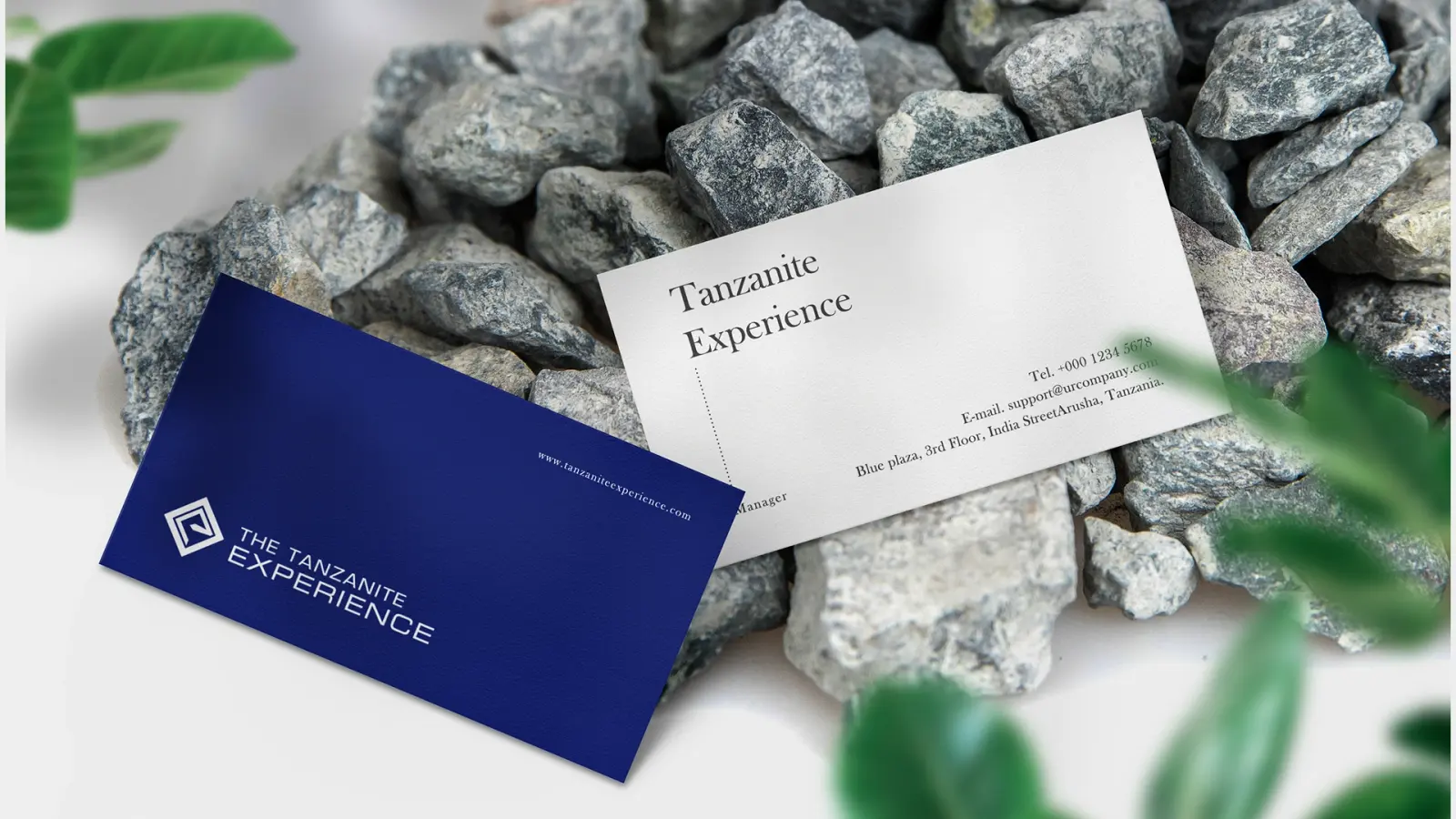
- A new logo and a bold, colourful palette led by the deep blue of the stone, so the brand reads as tanzanite at a glance.
- Packaging that carries the identity into the hand: a deep blue ring box, a drawstring pouch and a ribbon-handled carry bag, so a stone shipped overseas arrives looking as rare as it is.
- A rebuilt e-commerce website with animated sections that let the stone's colour and detail come through on screen, because for most international buyers the website is the showroom.
- Rules and templates for social content, so the always-on calendar stays recognisable whoever is posting.
Packaging deserves a special word. For a brand that ships worldwide, the box is often the only physical touchpoint a customer has, and it does the job a museum visit does in person. We go deeper into this in our packaging design work, and into the online side in website design and development.
Proof that travels: content, UGC, cinematography and reviews
Rarity is a claim. Content is how you prove it to someone who cannot visit, and this is where the three industry challenges came in.
First, a gemstone sells on detail, so cinematography mattered more than it does for most brands. GIA notes that tanzanite is pleochroic, showing different colours when viewed from different directions. Slow, close footage under moving light can show that in seconds; no paragraph can. We have written more about why this works in visual storytelling for brands.
Second, because few creators were making content about tanzanite, we treated content creation and UGC as something to build rather than wait for: brand-led content first, with real buyers' and visitors' content folded into the calendar as it came. UGC answers the question every overseas buyer has: do real people buy from this place, and are they happy?
Third, online reputation management (ORM). Someone spending serious money on a stone from another continent will read reviews before almost anything else. Keeping reviews answered and the brand's listings accurate is unglamorous work, and it is part of what turns interest into a purchase.
The client put it plainly: "Partnering with this agency has been a significant advantage for our content strategy." They also singled out responsiveness and deadlines, which matter more than agencies like to admit when the client is on another continent.
The scale test: Expo 2020 Dubai
Expo 2020 Dubai, which ran from October 2021 to March 2022, brought together 192 nations and, by the organisers' count, 24.1 million visitors. For the Tanzanite Experience it was a chance to stand in front of an international audience in person. Our work around the Expo covered collateral, conceptual advertising and content, made so that the identity carried into an exhibition setting without being redesigned for it.
This is the real test of a global identity. A brand system that only works on the website it was designed for will break the first time it has to sit on a stand among hundreds of other exhibitors. Because the positioning was a single idea and the identity was a system with rules, moving from screen to stand to print was a matter of applying it, not reinventing it.
Lessons for Indian brands planning a global rebrand
Plenty of Indian brands, and many in Jaipur, have the opportunity the Tanzanite Experience had: a product rooted in one place, with craft or materials that buyers abroad cannot get elsewhere. Gems and jewellery, hand-woven rugs, block prints, blue pottery. The lessons carry over, and for gem and jewellery houses we set them out in more detail on our jewellery branding page.
- Write the one-line truth before you design anything. If you cannot say why your brand matters in a sentence a stranger in another country understands, a new logo will not fix it.
- Design a system, not a set of files. Decide how the identity behaves on a phone, in print, on packaging and on a stand, and write it down so partners and new hires apply it the same way.
- Treat packaging as your showroom abroad. For anything you ship, the unboxing is the only time the customer holds your brand.
- Plan proof as carefully as the identity. Footage, UGC and reviews do the persuading that a shop visit does at home.
- Fix your reputation before you pay for reach. Ads send people to your reviews and listings, so make sure what they find there earns trust.
- Pressure-test on the biggest stage you can. An exhibition, a marketplace launch or a flagship retailer will show you where the system breaks while there is still time to fix it.
We saw the same pattern with Kaleen, a heritage rug maker taking its craft to global buyers. The brands that travel best are the ones that knew exactly what they stood for before they left home.
Questions people ask
What is a global rebrand?
A global rebrand reworks a brand's positioning, identity and voice so that it works for audiences in several countries, not only its home market. The core idea usually stays constant while details such as language, imagery and channels adapt to each market.
How long does a global rebrand take?
It depends on scope. A focused identity refresh is far shorter than a full programme covering positioning, identity, packaging, a new website and a content system rolled out across markets. Ask any agency for a phased plan with dates for each stage before you sign.
Should a brand change its name when it goes global?
Only if the name is hard to say, means something unfortunate, or is legally unavailable in a key market. The Tanzanite Experience kept its name because the name already said what made it rare, so the work went into building a brand that carries that meaning.
Where is the Tanzanite Experience?
The Tanzanite Experience is in Arusha and Manyara Kibaoni in Tanzania, and it ships jewellery and gemstones worldwide. It is home to the world's only Tanzanite Museum. The stone itself comes from a single source, the Merelani Hills in northern Tanzania, according to GIA.
Can an agency in India handle an international rebrand?
Yes, if it can show it has done the work. Our studio is in Jaipur, and the Tanzanite Experience in Tanzania and Kaleen's rugs for the global floor-covering market are two brands we have helped present to audiences beyond their home market. Ask to see the work and to meet the people who will actually do it.
Filed under Case notes. Written by the strategists at PixelOMedia, Jaipur.
How your brand looks, sounds and feels.
 The full case studyTanzanite Experience